The Neighborhood of Springdale

A History of Springdale

In the nineteenth century, the York area saw the rise of two residential estates remembered not only for their beauty, but for the social and political gravity that gathered inside their walls. One was Brockie. The other was Springdale. Brockie, on the south side of Country Club Road, was built in the 1860s by Jeremiah Sullivan Black, a towering legal figure of his era. Springdale, though, became the more enduring story for York County: it was created by an original York County family, held through five generations for well over a century, and known for hosting elite events where nationally prominent visitors appeared among local names.

1823: A summer place becomes a landmark

Springdale’s documented beginning is 1823, when Charles A. Barnitz purchased ten acres on the east side of the York & Baltimore Turnpike for a summer home. Barnitz was born in York in 1780, admitted to the bar in 1811, and married the daughter of Col. David Greer, an officer of the Revolutionary Army.

His public life was as expansive as his private ambitions. The account credits him as elected to the Pennsylvania Senate and later to the U.S. Congress as a Whig; as counsel for William Penn’s heirs in property litigation; and as president of the York Bank, then the only bank in the area. It also notes his role in forming the York County Colonization Society, and records the tradition that Springdale’s barns were “frequently a part” of the Underground Railroad.

What later writers call “early Springdale” was bounded by South George Street to the west, roughly today’s South Duke Street to the east, roughly Rathton Road to the south, and Hersh’s Lane (the first alley north of Springettsbury Avenue) to the north. The summer home was completed for occupancy in 1828.

Barnitz expanded eastward toward what is now Newlin Road, raising “Durhams” cattle and growing sunflowers for lamp oil. The narrative preserves a vivid domestic detail from a family letter: their daughter Jane once remarked that the cream was so thick her mother could churn butter “in a cup with a spoon at the table.”

Springdale’s story also touches the wider world through friendships. The text describes a bond between Barnitz and Lafayette, including an original letter said to exist in the York County Historical Society’s files. And it recounts Barnitz’s close social friendship with James Buchanan, often entertained at Springdale. It is “said” that Mrs. Barnitz named Springdale for seven springs on the property, at Buchanan’s suggestion.

Guests, impressions, and a sharp-tongued letter

During Barnitz’s term in Congress, Springdale hosted Henry Clay, Daniel Webster, and Davy Crockett in the early 1830s. The record includes a 1835 letter from Mrs. Barnitz to a niece, offering her frank impressions of Webster and Clay.

1837: A move, a purchase, and a new chapter

The business depression of the mid-1830s strained Barnitz’s finances. His only daughter Jane had married James Lewis and lived in Philadelphia. Arrangements were made for Lewis to purchase Springdale, and Lewis’s diary marks the moment with plain finality: “On Monday, 20th of March 1837 we moved to Springdale.”

Lewis hoped Springdale would encompass about 25 acres, from what is now George Street to Newlin Road, and from Hersh’s Lane southward across today’s Springettsbury Avenue to Rathton Road. The deeded transfer followed in 1841.

Lewis was the son of Major Eli Lewis (founder of Lewisberry) and brother of Ellis Lewis, who became Chief Justice of Pennsylvania’s Supreme Court. The text also notes Lewis’s own civic life: co-editor of the York Recorder, a director of York County’s first attempt at a public library, and later a president of the York Bank.

Inheritance arrives early, and often

Tragedy threaded itself through the ownership line. Margaret Jane, the Lewises’ only child, was born in January 1840; her mother Jane died six months later. Four years after that, James Lewis died as well, leaving Springdale to a five-year-old girl. Margaret Jane was raised by the Eli Lewis family, who moved to Springdale, with her uncle Eli Lewis acting as guardian.

In 1861 Margaret Jane married Samuel Spangler Hersh. Two years later, in 1863, the account marks two “important events”: she bought a 65-acre farm immediately to the east, extending the property’s reach to what is now Queen Street, and she gave birth to Grier Hersh, the only child of Margaret and Samuel to survive.

That newly acquired tract carried its own older associations. It had long been known as the Johnson farm, linked to Dr. Johnson (son-in-law of James Smith, the York attorney and signer of the Declaration of Independence). The farm buildings stood at what is now Springettsbury Avenue and Arlington Road. The farmhouse, James Smith’s summer home, was called Peacock Hall, named for peacocks painted over a living room fireplace. Tradition holds that during the Continental Congress’s York session of 1777–78, Smith entertained members of Congress there.

Springdale’s pattern repeated: shortly after Grier’s birth, Margaret Hersh died in 1865, devising Springdale to her son in a will written only a month before her death.

The Hersh era: expansion, spectacle, and daily life made grand

Samuel Spangler Hersh is described as a prominent York citizen: a director of the First National Bank of York, first president of the YMCA, and a founder of the York & Chanceford Turnpike. In 1868 he added 38 acres by purchasing the George Gotwalt farm (now the site of York Hospital). When Samuel died in 1876, Grier, only eleven, became a full orphan and sole owner; Samuel’s will named George Edward Hersh, his brother, as guardian.

Educated in private preparatory schools and at Princeton, Grier Hersh married Julia Mayer in 1887. Newspaper accounts called the wedding at St. John’s Episcopal Church on North Beaver Street “the most brilliant” in many a day. A choir was brought from Reading, and Hersh chartered a special train to Baltimore for the couple to begin their honeymoon.

Around this time, improvements reshaped Springdale’s grounds. The mansion was upgraded, the carriage house “as it exists today” was built, and a coachman’s house, formal gardens, and a swimming pool were added.

The narrative places Hersh at the center of York’s corporate and social world, listing presidencies at the York Bank, the Maryland Trust Company, the Pennsylvania Bankers’ Association, and the York County Gas Company, among other enterprises. It also notes that he chartered a private railroad car for winter trips to Palm Beach, where he helped found the Sailfish Club.

In 1894, Hersh brought golf to York by building the county’s first course at Springdale: nine holes, 2,281 yards in total, par 34. The text even preserves the period equipment: wooden-shaft clubs and gutta-percha balls, driven “about 100 yards.” It maps the course across familiar roads and lanes, tying the old estate to the modern street grid.

From estate to neighborhood

At one point, Springdale Farms totaled about 400 acres, stretching from Boundary Avenue southward to Violet Hill. As the city grew, Hersh sold hundreds of parcels for residential building lots. In the mid-1920s the development now known as Springdale was created, extending from Springettsbury Avenue to Rathton Road, and from Duke Street to Queen Street, with lots sold and homes built “largely through the promotions” of Harry S. Ebert and Augustus M. Hake.

“Early Springdale” stayed intact under Hersh until his death in 1941. The land now occupied by York Hospital had been purchased from him in 1925. Julia Hersh died in 1916; the couple had two children (Helen Hersh Torrance and Margaret Hersh Turner). In 1926 Hersh remarried to Helen Mayer, his first wife’s sister, who died soon after his own death.

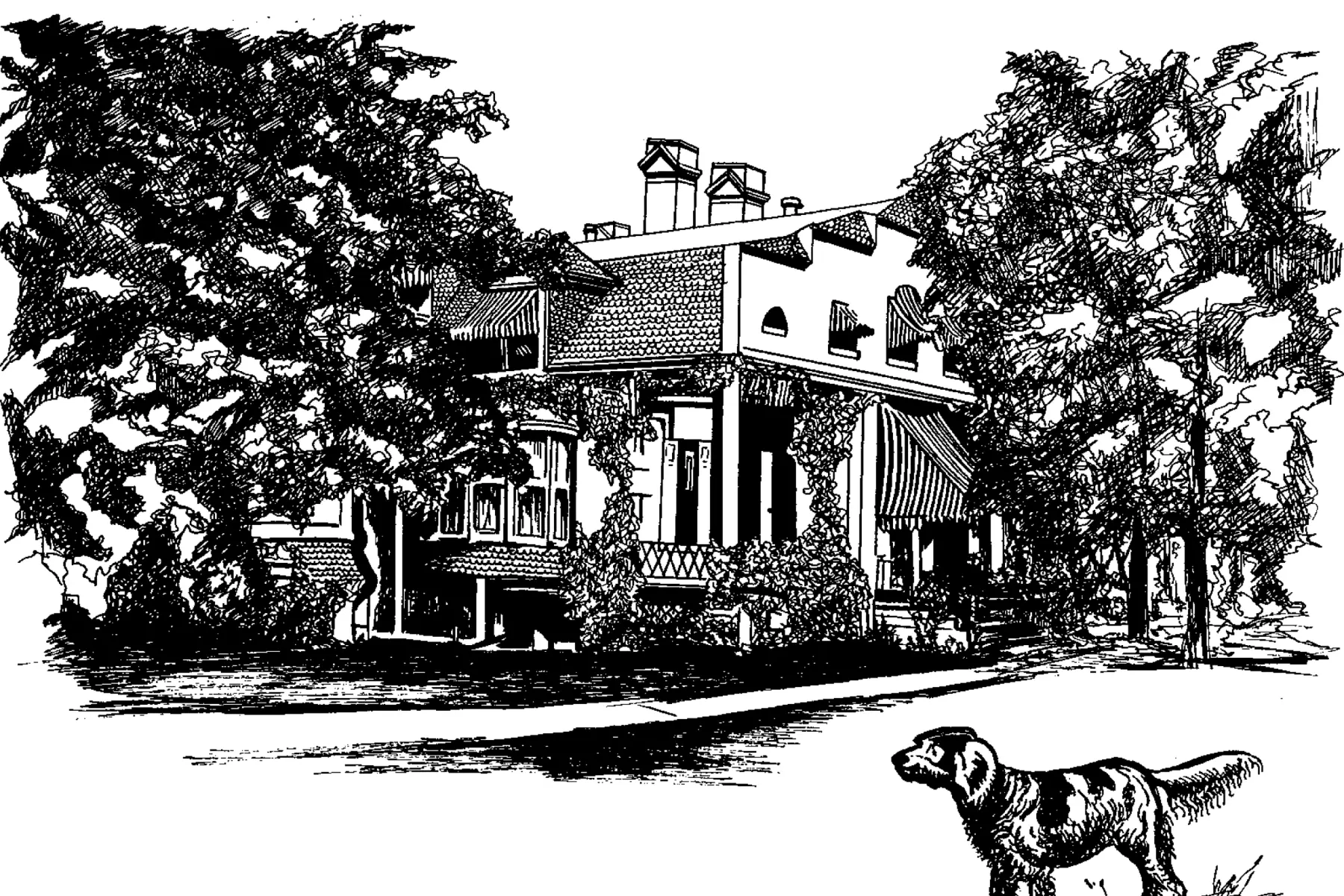
In 1945 the Hersh estate sold the property to Charles Pechenek, who remodeled the carriage house into a residence and, in 1954, demolished the mansion house. The text lingers on what was lost: a roughly forty-room home with a large ballroom, billiard room, unusually large library, multiple living rooms, sewing and laundry rooms, servant quarters, wine cellars, nursery, and a dining room paneled in soft red wood with a pinkish stone fireplace.

More details follow with a builder’s eye: an entrance hall with a wide staircase forming a gallery; an upstairs bathroom tiled in brown and tan; leaded “birdseye” windows; and a ballroom set below the reception hall, reached by wide steps, with chairs rimming the room when parties were in full swing. The gardens matched the house, with a gray fieldstone wall hiding sunken gardens from George Street, and trees still shaped as they were “in the old days.”

A later update records that the tea house, bath house, and swimming pool were demolished; and that in 1997 York Hospital (now WellSpan) sold the property to the Unitarian Universalist Congregation of York, which built a new sanctuary to complement the Carriage House, now used for administrative and meeting space.


How it felt: music, lanterns, and the stories that cling to old places

The source preserves a “local historian” vignette of Springdale evenings: carriages arriving for dances in an octagonal ballroom, musicales and theatricals indoors and out, formal gardens, a glassed-in porch turned conservatory, and croquet played after dark by candlelight.

It even adds the kind of detail that makes a past feel lived in: an orchestra, the story says, never stopped playing “no matter how late,” until the last dancer left.

And because old estates rarely travel into memory without a shadow at their heel, the account includes two pieces of folklore. One belongs to Brockie: on a moonless night, walking back Spring Lane off Country Club Road, a headless “old Brawkie” is said to chase intruders from a spring near the roadway.

The other is set at Springdale itself: in the 1860s, a visiting relative allegedly saw her suitor’s face pictured on a wall and heard a farewell, only to learn the next morning that he had died in an accident the previous evening.